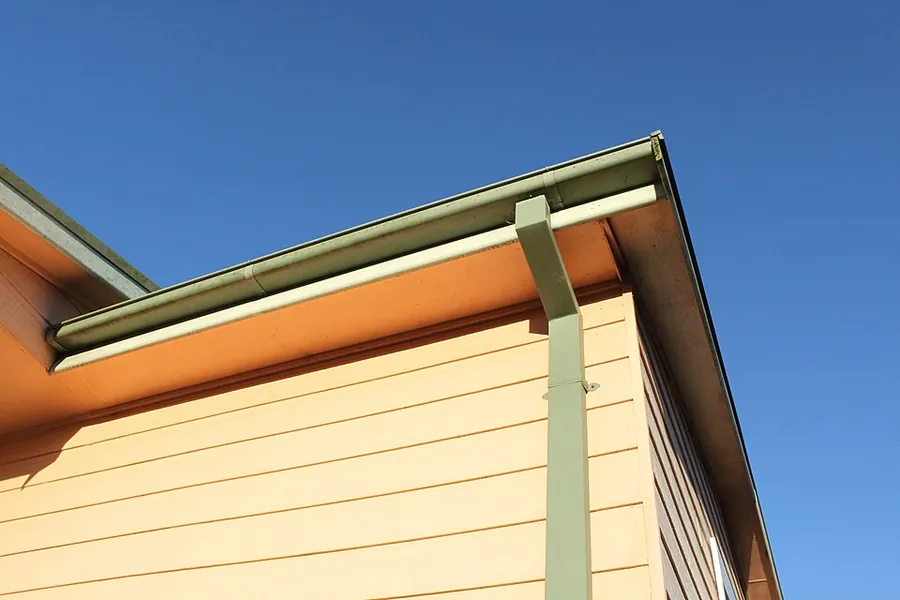
Gutters carry roof water away from walls and foundation. When they work nobody notices; when they overflow, the water lands where it does the most harm: stains and rot on siding and trim, erosion beside the foundation, and wet basements. Where the downspouts discharge matters as much as the gutters themselves.
Aluminum is the industry standard and lasts 20 years or more. Vinyl is cheapest and typically lasts 10 to 20 years. Galvanized steel is stronger. Copper and zinc are premium and can last many decades. Seamless gutters are formed on site to length, which means fewer joints to leak.
A rule of thumb from This Old House: divide square footage by 10 to estimate linear feet. A 2,000 sq ft house needs roughly 200 feet. Add downspouts, corners, and any leader to get water well away from the foundation.
.jpg)
What it costs
| Material | Materials only | Total with labor |
|---|---|---|
| Vinyl | $571 | $2,388 |
| Aluminum | $1,535 | $3,352 |
| Galvanized steel | $1,604 | $3,421 |
| Steel | $1,716 | $3,533 |
| Copper | $5,749 | $7,566 |
| Wood | $5,512 | $8,633 |
From This Old House using Homewyse data. Overall, This Old House cites $12 to $62 per linear foot, or $2,303 to $12,067 for 200 feet. HomeGuide puts gutter replacement at $12 to $25 per linear foot, and repair of leaks or sags at $100 to $450.
What moves the price
- Material
- Vinyl to copper is more than a 3x range.
- Linear feet and stories
- More feet and taller walls raise the price.
- Downspouts and discharge
- Long runs and underground drains add labor.
- Guards
- Quoted separately by many installers.
- Roof shape
- More corners and valleys mean more fittings.
Signs it is time
- Water spilling over the front during moderate rain
- Sagging sections or gutters pulling away from the fascia
- Staining or peeling paint behind the gutter
- Plants growing in the gutter, or seams that drip
- Soil erosion or standing water by the foundation
- Ice dams or heavy icicles that form at the same spot each winter
Questions to ask a pro
- What material and size (5-inch or 6-inch)?
- Seamless or sectional, and how long is each run?
- Where will each downspout discharge, and how far from the foundation?
- Are guards included or optional, and which kind?
- Will you reuse the existing hangers or install new ones, and how many per foot?
Common questions
Can I clean instead of replace?
If the gutters are sound but clogged, cleaning and resealing seams may be all you need. If they sag or leak at the seams repeatedly, replace.
Do I need gutter guards?
Guards cut down on cleaning but are not maintenance-free. They help most under heavy tree cover.