Key takeaways
- One regional cost site puts a 2,000 sq ft architectural asphalt roof in Baltimore-Columbia-Towson at $13,000 to $22,000. This Old House’s national estimate for the same size, based on Homewyse data, is $15,439.
- Many Baltimore rowhomes do not have a shingle roof at all. Their roofs are flat or slope gently to the rear, and they take a membrane system. This Old House lists $7 to $13 per square foot for those systems.
- Roofs are on Maryland’s list of work that usually requires a licensed home improvement contractor. Check the license, and know that a contractor cannot take more than one-third of the price as a deposit.
- Permit rules differ between Baltimore City and Baltimore County, and a historic district adds a review step. Call the permit office before work starts.
- The Baltimore airport station averages 45 inches of precipitation a year and about 93 nights at or below freezing, so a roof here sees steady rain and a freeze-thaw cycle every winter.
The short answer
If your roof has a pitch and shingles, you are looking at roughly the same project as anywhere in the country, priced anywhere from a little below to well above the national estimate if you believe the regional figures. If you live in a rowhome, there is a good chance your roof is something different, and that changes the material, the permit question, and the kind of roofer you want.
This page covers the parts that are specific to the Baltimore area. For the general mechanics of a roofing quote, see our national roof replacement cost guide. Two companion articles go further on the flat roofs common on rowhomes and on city and county permits.
What kind of roof you probably have
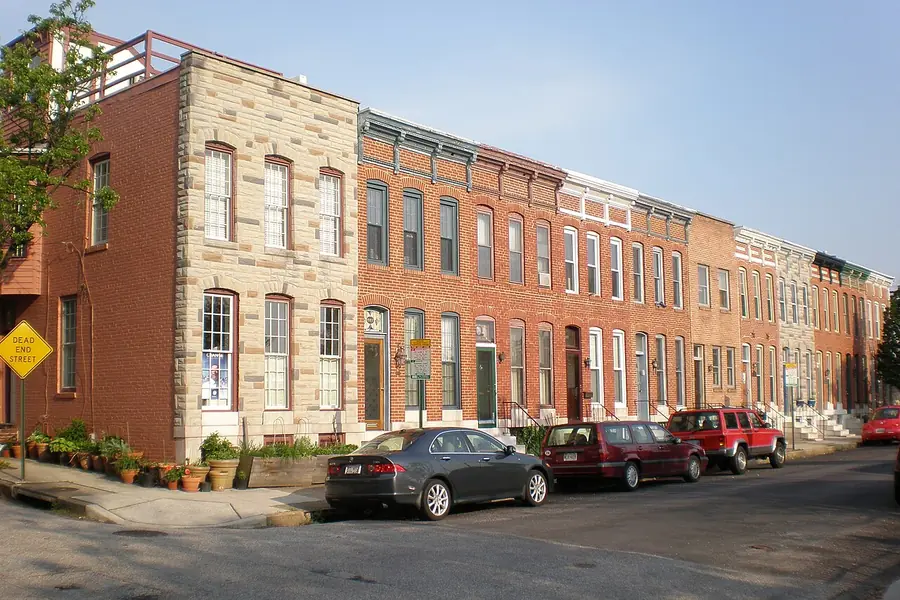
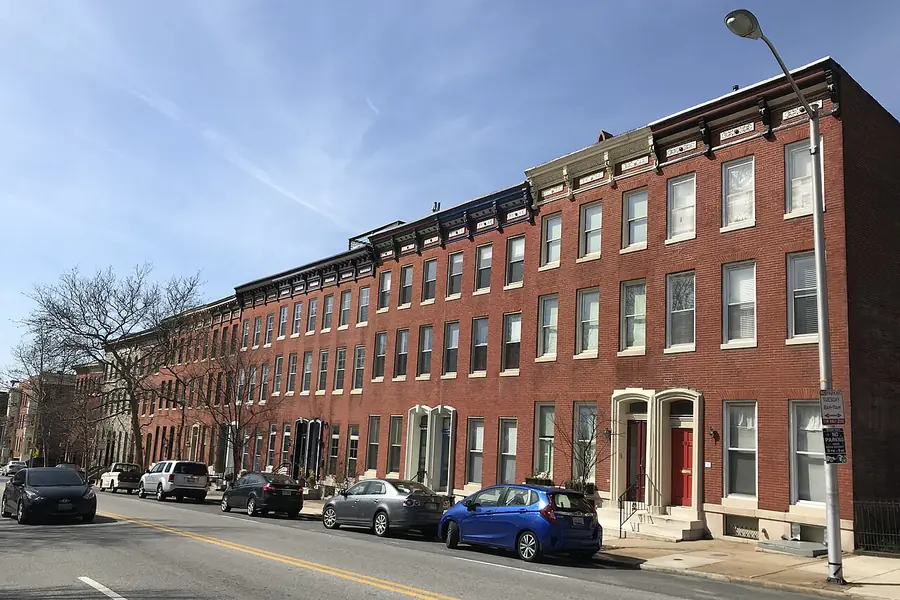
Baltimore Magazine reports that half of the city’s 251,000 occupied housing units are attached single-family dwellings, the category that holds the rowhome. The National Park Service nomination for the Butchers Hill historic district describes the pattern: houses built before 1860 generally have low gabled roofs between tall party walls, and houses built after 1860 generally have rear-sloping shed roofs. A rear-sloping shed roof on a brick rowhouse is usually a low-slope roof, and a low-slope roof is roofed and repaired like a flat one.
.jpg)
Outside the city, the houses of Baltimore County and the surrounding suburbs include more detached and semi-detached houses with a pitched roof, though the County has rowhouse neighborhoods too, and for pitched roofs the shingle-or-metal question applies. If you are not sure which you have, look at the roof from an upper window or have a pro measure the slope. That decides which materials apply, as the materials section below shows.
What the weather asks of the roof
NOAA’s 1991 to 2020 climate normals for the Baltimore/Washington International Airport station show about 45 inches of precipitation a year, about 19 inches of snow, and about 93 nights a year with a low at or below freezing. A roof here sees steady rain and a freeze-and-thaw cycle every winter, and those two things find the weak spots: flashing at party walls and parapets, drains that clog, seams that open. This Old House notes that modified bitumen is popular in the Northeast because freeze-thaw cycles can destroy other flat roofing materials.
These are airport readings, so your block will differ.
What it costs
There is no official Baltimore price list for roofing, and the figures people quote online vary a great deal. These are the ones we could trace to a named source. Four of the five are national, because the national sources publish the flat roof data and the regional ones do not.
| Roof type | Figure | Source and basis |
|---|---|---|
| Asphalt shingles, 2,000 sq ft, Baltimore-Columbia-Towson | $13,000 to $22,000 | Modernize regional estimate for architectural asphalt shingles; its estimates typically include tear-off |
| Asphalt shingles, 2,000 sq ft, national | $15,439 | This Old House national estimate (Homewyse data), 2,000 sq ft asphalt |
| Modified bitumen flat roof, 1,000 sq ft | $6,760 to $9,121 | This Old House with Homewyse data, national, builder-grade |
| Modified bitumen flat roof, 1,500 sq ft | $10,059 to $13,569 | Same source and basis |
| Flat roof systems, per sq ft | $7 to $13 | This Old House: modified bitumen and built-up $7 to $9, membrane $7 to $10, TPO $8 to $11, rubber $9 to $13 |
Modernize is a lead-generation site, so treat its range as a regional estimate, not a market survey. None of these figures is a quote.
Rowhome jobs carry costs that the national tables do not show. This Old House notes that hard-to-reach roofs, limited workspace, and buildings where materials cannot be lifted easily push labor higher. A narrow rear alley, a three-story climb, or a roof deck that has to be protected and put back are all cases of that. Ask each roofer to say what they assumed about access.
Roof size on a rowhome is also not a standard figure. Measure the footprint of the roof you want covered, or have the roofer put the measured area on the estimate, before you compare prices per square foot.
Materials by house type
| House | Typical roof | Materials that fit | Watch for |
|---|---|---|---|
| Rowhome with a flat or shed roof | Low slope, rear drain or scupper, parapet walls | Modified bitumen, EPDM, TPO or PVC membrane, built-up roof | Flashing at party walls, drain condition, whether a deck sits on the roof |
| Rowhome with a pitched front or mansard section | Mixed: steep front, flat behind | Shingle or slate on the steep part, membrane on the flat part | Where the two systems meet; two trades on one roof |
| Detached or semi-detached house | Pitched, gable or hip | Architectural asphalt shingles, metal, slate where it already exists | Ice barrier and drip edge at the eaves, ventilation, deck rot under old layers |
| House in a historic district | Whatever is original | Materials that visually match what is visible from the street | Review by the city’s preservation commission before the permit |
Our summary. In a city historic district, the preservation guidelines say flat or gently sloping roofs not visible from the ground may be replaced with modified bitumen or single-ply membranes such as EPDM and TPO.
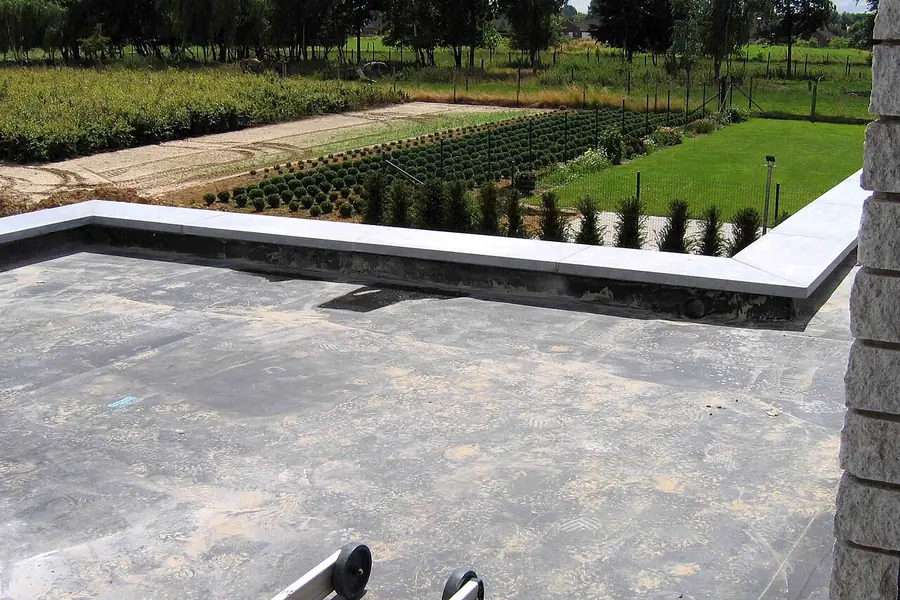

The reasons behind the table are in the flat roof article, including a ballpark calculator for each system. A roof system is chosen by the roof’s slope first and by price second.
City and county permits
Baltimore City and Baltimore County are separate jurisdictions with separate permit rules, and a historic district adds a review step in either one. The permits article covers each case, with phone numbers and what to ask your roofer.
Hiring in Maryland
Maryland licenses home improvement contractors through the Maryland Home Improvement Commission. Its list of work usually required to be licensed includes roofs, gutters and downspouts, siding, and chimney repairs, and the law provides that only licensed contractors may enter into contracts with homeowners for home improvement work. Four checks:
- Look up the license. Use the Commission’s online license search by name or number. Confirm the status is current and that the name matches the one on the estimate. The Commission’s phone line is 410-230-6231.
- Read the contract for the required items. Per the Commission, a home improvement contract must be in writing, legible and signed by each party, describe the work and the documents it relies on, show the contractor’s name, address and MHIC license number, give approximate start and substantial-completion dates, and include notices about the Commission’s Guaranty Fund and the homeowner’s right to purchase a performance bond.
- Check the deposit. A contractor cannot accept more than one-third of the contract price as a deposit, and nothing before the contract is signed.
- If the house was built before 1978, ask whether the firm is EPA lead-safe certified. The Commission notes that EPA requires certification and lead-safe work practices for renovation that disturbs lead-based paint on 20 square feet of exterior surface, which can include painted trim and cornices.
We do not vouch for any contractor, and nothing here claims that a particular firm is licensed or insured. A license does not tell you the roofer is good. It means the state has licensed them, and that you may be able to claim against the Commission’s Guaranty Fund for certain losses a licensed contractor causes. Check the license yourself before you sign.
Where we take requests
We take roofing requests from Baltimore City and the rest of the Baltimore-Columbia-Towson area, including Baltimore, Howard, Anne Arundel, Harford and Carroll counties. Our referral network is still small. We will tell you plainly if we do not have an independent pro for your address, and we will not pass your request to someone who does not work in your area. The permit rules on these pages cover Baltimore City and Baltimore County only. Howard, Anne Arundel, Harford and Carroll counties each have their own permit office, so check with yours.
Ask for a Baltimore-area roofer
Tell us what the roof is and where it is. We review each request. If we have an independent pro who works your area, we send your request to them and they contact you. You choose who to hire.
Common questions
Do I need a permit to replace my roof in Baltimore?
It depends on the jurisdiction and the job. Baltimore City and Baltimore County have different rules, structural work and deck repairs change the answer, and so does a historic district. Our permits guide walks through the cases and lists the phone numbers. Call the permit office before work starts.
How do I check a Baltimore roofer’s license?
Roofs are on the Maryland Home Improvement Commission’s list of work that usually requires a licensed contractor. Look up the contractor by name or license number in the Commission’s online license search, and make sure the license number is printed on the contract. You can also call the Commission at 410-230-6231.
How big a deposit can a Maryland contractor ask for?
The Commission says a contractor cannot accept more than one-third of the contract price as a deposit, and cannot accept any payment until the contract is signed. A smaller deposit can be negotiated.
Can shingles go on a rowhome’s flat roof?
Usually not. Asphalt shingles shed water on a pitched roof, and the model building code sets a minimum slope for them. Many rowhome roofs are flat or slope gently to the rear, and those are normally covered with a membrane system such as modified bitumen, EPDM, or TPO. A pro who looks at the roof can tell you what its slope allows.
How much does a flat roof cost for a rowhome?
This Old House, using Homewyse contractor data, lists $7 to $13 per square foot for the common flat roof systems. At 1,000 square feet, modified bitumen came to $6,760 to $9,121 in its example. These are national figures for builder-grade materials; a rowhome with a tight alley, high parapets, or a deck to protect will price differently.
How long does a flat roof last?
This Old House says flat roofs typically last 15 to 20 years depending on the material, and that EPDM rubber usually lasts at least 20 years and can last far longer with maintenance. Drainage and flashing quality matter as much as the product.
Sources
- Modernize, How Much Does Roof Replacement Cost in Maryland in 2026? (lead-generation site; Baltimore-Columbia-Towson range)
- This Old House, How Much Does a New Roof Cost? (2026)
- This Old House, Flat Roof Replacement Cost (updated March 2026, Homewyse data)
- This Old House, Rubber Roof Installation Cost (updated June 2026)
- NOAA NCEI, 1991-2020 annual and seasonal climate normals, Baltimore/Washington International Airport station USW00093721 (data file: annual precipitation, snowfall, freezing nights)
- Baltimore Magazine, Anatomy of a Baltimore Rowhome (May 2025)
- National Park Service, Butchers Hill historic district nomination (roof forms in Butchers Hill)
- Baltimore Heritage, Resources for Historic Homeowners
- Baltimore City Historic Preservation Design Guidelines (CHAP, updated 2022), section 1.8 Roofs
- Maryland Home Improvement Commission, What Is Home Improvement?
- Maryland Home Improvement Commission, Home Improvement Contracts
- Maryland Home Improvement Commission, License Search